Showing posts with label non-fiction. Show all posts

Saturday, 15 March 2014

Mishel Reviews: Princesses behaving badly - Linda Rodriguez McRobbie

Series or Stand Alone: Stand Alone
Release Date:  November 2013 
Publisher: Quirk Books
Pages: 288
My Rating: 4/5
Source: Received from publisher for review
Cover: It’s pretty creative; I like it, although the princess at the very top looks very manly…

You think you know her story. You’ve read the Brothers Grimm, you’ve watched the Disney cartoons, you cheered as these virtuous women lived happily ever after. But the lives of real princesses couldn’t be more different. Sure, many were graceful and benevolent leaders—but just as many were ruthless in their quest for power, and all of them had skeletons rattling in their royal closets. Princess Stephanie von Hohenlohe was a Nazi spy. Empress Elizabeth of the Austro-Hungarian Empire slept wearing a mask of raw veal. Princess Olga of Kiev murdered thousands of men, and Princess Rani Lakshmibai waged war on the battlefield, charging into combat with her toddler son strapped to her back.  Princesses Behaving Badly  offers mini-biographies of all these princesses and dozens more. It’s a fascinating read for history buffs, feminists, and anyone seeking a different kind of bedtime story.

Review:
I know the whole Disney princess franchise is a rip-off and may or may not be detrimental to young girls today. But honestly, I like Disney princesses…to a certain extent. Do I like that most of them (the earlier ones especially) need a prince to have their Happily Ever After? No, I don’t like that fact or many others. But I’m a sucker for fairy tales and the entire idea of what a Disney princess is appeals to me for some reason. I have a three year old daughter that loves all things Disney princess-related. Do I want her to eventually grow out of it though? Hell yes! But this isn’t a rant or discussion about Disney princesses. I brought Disney up because unfortunately that’s my only real knowledge of princesses. But real life princesses – the ones who fight for their freedom, scheme for power, lie, cheat and steal for gain are the ones featured in this book. These women are nothing like the princesses I grew up with but I became truly fascinated by so many of them after reading Princesses Behaving Badly.

I love the fact that this is such a fun, light, and fluffy read. These short, mini-biographies of the royal women of history is not only fascinating but an excellent introduction to a lot of women I hadn’t even heard of before. A number of their stories intrigue me enough to want to go off and explore more about their lives. It got especially exciting for me as the author moved closer to the current time period and even included some women who were still alive or had recently just passed within my lifetime. I do believe there was no intention of a deep, methodically researched portrayal of these women and honestly that’s what makes this read so much fun and so easy to read. McRobbie provides just enough insight to attract even the most reluctant historical reader. The gossip-rag style of delivery brings a modern outlook on these women and the choices they voluntarily made or were forced to make during their lives. Again, I think it’s a brilliant way to interest young and older readers alike. 

Although I’m sure all facts are as reliable and accurate as possible I don’t think one should look upon this book as a serious read. I think it was meant to shed light on royal women, (including empresses, ones that may only be myths, ranis – which means “queen” or “lady” in many Indo-Aryan languages, khans – yes think Genghis!, and even imposters) that have “made the headlines” in their day. While most of these princesses were definitely behaving “badly”, even downright insane in some cases, some were merely stepping over boundaries that were frowned upon greatly or doing things other women would only dream of.  The majority of these ladies never got their fairytale happily-ever-afters but they led extraordinary lives that over time have come to inspire and/or entertain the masses; a big accomplishment in its own right!




Thursday, 12 September 2013

Review: Noble Endeavours - Miranda Seymour

In 1613 a beautiful Stuart princess married a handsome young German prince. This was a love match, but it was also an alliance that aimed to weld together Europe's two great Protestant powers.
Before Elizabeth and Frederick left London for the court in Heidelberg, they watched a performance of The Winter's Tale. In 1943, a group of British POWS gave a performance of that same play to a group of enthusiastic Nazi guards in Bavaria. When the amateur actors suggested doing a version of The Merchant of Venice that showed Shylock as the hero, the guards brought in the costumes and helped create the sets.

Nothing about the story of England and Germany, as this remarkable book demonstrates, is as simple as we might expect. A shared faith, a shared hunger for power, a shared culture (Germany never doubted that Shakespeare belonged to them, as much as to England); a shared leadership. German monarchs ruled over England for three hundred years - and only ceased to do so through a change of name. 
 
My thoughts:
A lot of history, a lot of interesting people.

The thing about this book is that I liked some of the chapters and some not so much. The problem I had with some chapters is that the writing style was too much at once. It seemed like the author wanted to put in a lot of information and by doing that she jumped from one interesting person to another one and to another one and to another one, and then back to the first one.

So with those chapters I would have wanted less and more. Less people, and more information about the people in the book. I am like that, I always want more and here there was not enough.

Ok to the chapters I liked then, they were more fleshed out but I would have wanted even more. As I said there are A LOT of people mentioned in this book and some interesting ones were about Queen Victoria and her children. And the Winter Queen.

Conclusion:
For the historical non-fiction lover this is a true treasure. 300 years of history between Germany and England. A lot of people that were new to me, some I did not know a lot about and all the rest. And they sure wanted to better the relationship between the countries.

Hardcover, 512 pages
Published August 29th 2013 by Simon & Schuster UK
Non-fiction
From the publisher for a review

Sunday, 5 February 2012

Review: The Discovery of Jeanne Baret - Glynis Ridley

The Discovery of Jeanne Baret: A Story of Science, the High Seas, and the First Woman to Circumnavigate the Globe
Genre: non-fiction, historical
Target audience: adults
Publisher: Crown
Published: December 2011
Book form: paperback, 291 pages
Review by Anachronist

Synopsis (from Amazon.com):

The year was 1765. Eminent botanist Philibert Commerson had just been appointed to a grand new expedition: the first French circumnavigation of the world. As the ships’ official naturalist, Commerson would seek out resources—medicines, spices, timber, food—that could give the French an edge in the ever-accelerating race for empire.

Jeanne Baret, Commerson’s young mistress, housekeeper and collaborator, was desperate not to be left behind. She disguised herself as a teenage boy and signed on as his assistant. The journey made the twenty-six-year-old, known to her shipmates as “Jean” rather than “Jeanne,” the first woman to ever sail around the globe. Yet so little is known about this extraordinary woman, whose accomplishments were considered to be subversive, even impossible for someone of her sex and class.
            
When the ships made landfall and the secret lovers disembarked to explore, Baret carried heavy wooden field presses and bulky optical instruments over beaches and hills, impressing observers on the ships’ decks with her obvious strength and stamina. Less obvious were the strips of linen wound tight around her upper body and the months she had spent perfecting her masculine disguise in the streets and marketplaces of Paris.
            
In The Discovery of Jeanne Baret, Glynis Ridley unravels the conflicting accounts recorded by Baret’s crewmates to piece together the real story: how Baret’s identity was in fact widely suspected within just a couple of weeks of embarking, and the painful consequences of those suspicions; the newly discovered notebook, written in Baret’s own hand, that proves her scientific acumen; and the thousands of specimens she collected, most famously the showy vine bougainvillea.

What I liked:

This book is definitely a very well-researched position which presents plenty of interesting facts concerning life and habits of people living in the 18th century in France and abroad. Although the main emphasis is on the ethnobotanical tradition and, more generally, French scientists and thinkers such as Jean le Rond d’Allembert, Denis Diderot, Jean-Jacques Rousseau and Voltaire, the ordinary people and their fates are mentioned often as well, especially women.

The narrative voice of Ms Ridley is quiet and pleasant although you really must take your time to get into the book. When you finally find the right rhythm, though, you can find such interesting historical tidbits as a short history of the coffee trade, and a fresh look into the situation of women in France prior to the Great Revolution (I didn’t know that they were not allowed to rent a flat on their own or stay on a ship for longer than just a moment – it was the law mind you!)

Overall, if you are a girl/woman living in Europe or in the USA, after reading this book you might stop complaining about your life for a significant period of time. The fates of women used to be much, much worse, especially poor, uneducated women who, like Jeanne, gave birth to an illegitimate child.

What I didn’t like:

With a title like that, I expected the book would be more focused on the main heroine, Jeanne Baret, who was the first woman to make a tour around the world on a ship. In other words, I expected a portrait, perhaps with some other people close to her and some plants in the background. What I got was a full-scale landscape, teeming of different people, plants, breathtaking vistas, ships, cities, and even animals. The heroine was a bit lost in the middle of all these goodies and, in my opinion, the whole book suffered because of that.

Don’t get me wrong – we still get to know plenty about Jeanne, her family and her profession. However, it is a bit too diluted; as soon as you start getting interested in the story of this strong and undoubtedly very brave woman the author throws your way one digression after the other; even if these are interesting per se, they dwarf poor Jeanne and her ordeal, making the book bland as a result. Pity.

Final verdict

I feel Jeanne Baret’s life deserves our full attention – I suppose she would be a great heroine of a truly gripping fictional story. Let me use this section to tell you why I think so.

This peasant female botanist was literate in times when 90% of women couldn’t read and write but still she couldn’t support herself without relying on Philibert Commerson. She supported his career, teaching him about plants and their properties. She had to give up their child to an orphanage because the boy would be an obstacle to Commerson’s plans. She worked very hard during circumnavigating the globe – harder than plenty of men around her, harder than her official employer and secret lover. She had to conceal her sex while living on a rather small ship full of men. She had to take care of Commerson’s ailing leg and the plants they gathered together. In return she was gang-raped by the crew at least at one occasion and her selfish employer failed to defend her. After Commerson’s death, she was left high and dry - far from home with just clothes on her back – their house in Paris with everything inside has been impounded. And, miraculously, she still found her 'happily ever after' – married a soldier, returned with him to France and made a life together.

Was her time with Commerson a complete failure? No. He taught her independence and she used that knowledge – after returning to France she petitioned the ministry and received her outstanding wages – a lump sum which made it possible to buy a house and some land. I love such endings!


Sunday, 25 September 2011

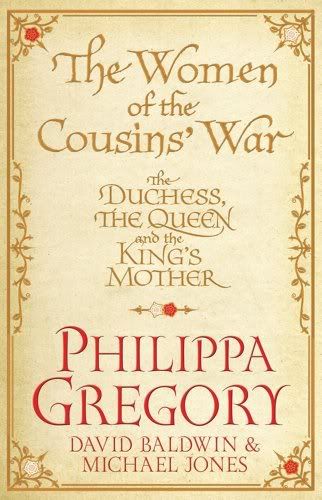
Review: The Women of the Cousins' War: The Duchess, the Queen and the King's Mother

Genre: Non-fiction
Pages: 338
Published: September 15, 2011
Publisher: Simon and Schuster ltd
Source: For review

#1 New York Times bestselling author Philippa Gregory and two historians present a must-have non-fiction book for both fans and scholars.

My thoughts:
I have actually never reviewed non-fiction before, and in the end I have not read much either, since my non-fiction mostly consists of uni textbooks (and none that exciting as this one). After having read all 3 books by Philippa Gregory it was interesting to read this book since this one is all fact and thoughts about these three women. But how to review is the question. I can't say I did not like something that happens since it is what happened. So I looked at is this way, was it boring and made me fall asleep? The question to that is no. It was never dry.

Philippa Gregory has written the first part about Jacquetta and she tells the story from cradle to grave. The little that is known about this fascinating woman. I do love any woman who went her on way at a time where your father, husband, brother or king ruled you. Sure many other women went their own way, but I just like how she married so far beneath her status, she must have loved him so and I am a sucker for that.

The next part is by David Baldwin and he tells the story about Elizabeth Woodville. I will always like the Woodville family and they are just so slandered, it is horrible. They were certainly not the first family to gain lands, titles and money when someone from their family caught a king's eye. And even if her husband was a terrible womanizer I will always like their story, lust at first sight ;)

The last part is by Michael Jones and it is about Margaret Beaufort (whom I called the bitch in The Red Queen). It is strange to say that you do not like someone that has lived and you have never met, but I just do not like it (but her story is a good one), and I certainly do not like her son Henry Tudor. Lol, I have a strange aversion for all the Tudors for some reason. Well starting from Henry. Oh and I am sure these two killed the princes in the tower, ok, I am just blaming them since I dislike them.

All in all 3 good authors writing about 3 interesting women, that history has vilified or as with Margaret made all saintly and good. It is not perhaps a book you read at once. No, you can read one section and then read another another day. History is not going anywhere.

Conclusion:
A good book to read after reading this series, or a good book to make you want to read the Cousin's War books.

Rating: 
Interesting

Cover:
I can't grade non.fiction, it fits


About Me

My photo
I am young Finnish woman lost in a world of books.

Publishers/authors:I am open for reviewing books so please contact me if you want your book reviewed.

Look at my review policy for more info
I review from most genres on this blog, and those genres are: fantasy, urban fantasy, YA, historical/+romance, contemporary romance and literary fiction, horror, thrillers. + some other genres read by my guest reviewers.

Disclaimer: Books reviewed on this site are my own, if not stated otherwise. Then they were sent for free by the author, publicist or a publisher. I do not get any compensation for my reviews. I do this all for fun.google-site-verification: googlec45f9c3acb51f8cd.html
Copyright © 2008-2020 Book Girl of Mur-y-Castell All Rights Reserved. Proudly powered by Blogger

  © Blogger template Starry by Ourblogtemplates.com 2008 Modified by Lea

Back to TOP